26 January, 2017

America and Fascism: Yeah, it's a thing.


*** Please be advised...I recently finished watching Oliver Stone's 12 part documentary The Untold History of the United States. It was very insightful and surprisingly not as conspiracy theory as I thought it would be (Mr. Stone seemed to want to go there during the Kennedy segments but stoped just short). After watching that, I decided to write this piece because of what is going on right now in America.  My aim here is not to say that President Trump is a fascist . It just seems like the way things are going, fascism is now a much more realistic exit ramp. Only time will tell how things go but it doesn't too good right now. What is written here is my opinion and it deals mostly with the past because America has a chronic problem with repeating it's mistakes. Thank you for your time. ***

The picture is from the cover of a book by Charles Higham about wealthy American industrialists financing European fascism in the 1930's. You see, American industrialists and bankers have always had a bit of a soft spot for fascism (fascism and communism are ideologically opposed to one another and America hates communism so we tend to look the other way with fascism). I thought this subject seemed relevant because Donald Trump was just sworn in as the 45th President of the United States and the Trump rise is a little on the tyrannical side. Anyway, let's go back to the days of yesteryear, 1933 to be exact. America was in the grips of a crippling economic depression. Franklin D. Roosevelt won the presidential election of 1932 with a platform based on the government providing jobs for the vast amounts of unemployed (this was the foundation of The New-Deal).

Suffice to say Roosevelt's New Deal was seen by bankers as a sign of communism (the scariest mother f*ckin thing for bankers, industrialists and capitalists!). These same people also weren't keen on legislation like the Glass-Steagall Act, which prohibited commercial banks from engaging in the investment business (this is a very simplified definition). These things began to add up and something about this president that was unfriendly to business (this is a narrative that's been heard a lot lately, keep in mind that the country had a 25% unemployment rate and these "job creators" had an issue with the president putting people to work). Thus was hatched the "The Business Plot."


This banking cabal approached two time Medal of Honor recipient Major General Smedley Butler. A staunch republican that supported Roosevelt after President Hoover sent in Doug MacArthur to bust up the Bonus Army encampment in 1932. Butler was a Marine who served gallantly in America's turn of the century wars and military actions, some noble causes and some not so much. What the banking cabal didn't count on was General Butler's loyalty to America (not capitalism) and the president. He turned them in. After a congressional hearing, it was determined that there was a plot but in a trend that would hold true today, no one went to jail (bankers just don't go to prison). This was from the committee's final report to Congress...
"In the last few weeks of the committee's official life it received evidence showing that certain persons had made an attempt to establish a fascist organization in this country...There is no question that these attempts were discussed, were planned, and might have been placed in execution when and if the financial backers deemed it expedient." Thanks McCormick-Dickstein Committee! Way to sit on the fence!
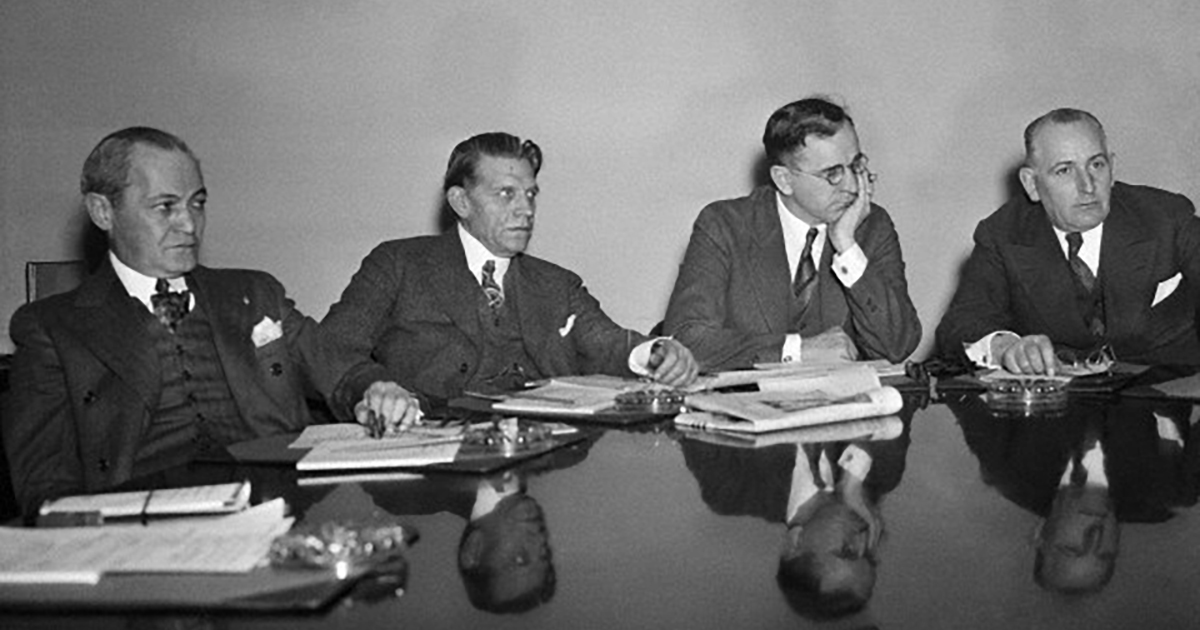
Special Committee on Un-American Activities or stock photo of 30's businessmen. Too close to call.

So what do you think happened to the decorated veteran and patriot General Butler? Was he embraced by Roosevelt or at least given a "thanks man?" Is he in the history books as a great American hero and patriot? Did he get a sweet book deal and a high paying gig on the lecture circuit? Wrong on all counts. If you guessed that Butler was discredited by the media and faded into obscurity then you'd be correct! The media at the time regarded this as nonsense or as the New York times called it, "a bold and unconvincing narrative," despite the findings of the HUAC. Who were the conspirators you ask? It was a group of wealthy businessmen that allegedly included the heads of Chase Bank, GM, Goodyear, Standard Oil, the DuPont family and Senator Prescott Bush. Prescott Bush being the father of President George H.W. Bush and grandfather to President George W. Bush. More on Prescott in a bit.

Over in Europe around this time, Hitler's Nazi Party and Mussolini's Black Shirts were solidifying their power in Germany and Italy. They got plenty of financial help from Wall Street, most notably Chase Bank. They helped the Nazis raise $20 million between 1936 and 1941 (netting them a cool $1 million in commissions) and of course seized assets of European Jews. Unfortunately, Chase wasn't the bank that cashed in on this practice. Even Prescott Bush had direct and indirect financial dealings with the Nazis up until 1942 (the US declared war on Germany right after Pear Harbor in 1941, let that sink in). 

Speaking of profits by working with the Nazis, IBM has an awful history. IBM founder Thomas Watson began work with the Nazis in 1933. IBM and their German subsidiaries developed punch card technology  that enabled them more efficiently catalog European Jews (they didn't stop at Jews either, gypsies an others fell victim as well) to essentially locate them, hunt them down and exterminate them. It should be noted that IBM's German division paid $3 million into a Holocaust survivor fund in order to sidestep a lawsuit in 2001. Of course, IBM wanted to make sure that the payment was not an admission of guilt.  

Then there was the Spanish Civil War from 1936 to 1939. Several American companies backed the right wing nationalist, Francisco Franco. Franco's party lost in the 1936 election and attempted a coup that precipitated the war. A lot of the same culprits that helped Hitler were all too eager to help Franco. The most notable was Texaco. 

Torkild Rieber, Texaco's chairman, was providing Franco with oil on a huge line of credit. Roosevelt went so far as to fine Texaco $22,000 but that didn't deter Rieber. By the end of the war, Texaco delivered 3.5 million tons of oil for a cool $20 million. All this despite a looming threat of an embargo from Roosevelt. Rieber also had financial dealings with the Nazis as well. He managed to ship the Nazis oil from Columbia despite a British embargo of Germany at the time. According to Maurice Erzan's 2010 book, Histoire du pétrole, Rieber and executives of IT&T, General Motors and Ford met in New York City with German agent Gerhardt Alois Westrick to celebrate the fall of France in 1940. Eventually Texaco got rid of the guy. After he made them a lot of money of course and only after bad press.

Roosevelt's Vice President Henry Wallace was quoted as saying, "a fascist is one whose lust for money or power is combined with such an intensity of intolerance toward those of other races, parties, classes, religions, cultures, regions or nations as to make him ruthless in his use of deceit or violence to attain his ends." Sound like some people in public office that we know? By the way, Henry Wallace was disliked by a lot of the same bankers and industrialists mentioned earlier. Being Roosevelt's VP was a huge reason but when he said something along the lines of equal pay for all genders and creeds and that threw people into a tizzy. After serving three terms as Roosevelt's VP, it was comments like that which helped in him being kicked off the ballot and being replaced as the vice presidential nominee with Harry Truman and the 1944 Democratic National Convention.

This clip might not be that pertinent to the post but it brilliantly sums up the 2016 election in less than 60 seconds. It's also good for a few yucks as well. 

I wanted to close with something poignant but I came up with this instead. America has a weird relationship with fascism. The average person most likely doesn't like fascism. However, the wealthy industrialists seem to have a morally casual attitude in regards to fascism so long as the money keeps rolling in. I focused on 1933-1940, it was going in the twenties and it hit its stride after World War II. America is in a weird place right now. It's really hard to predict what could happen but the downside could be potentially disastrous. 

22 January, 2017

2016 Films: #37. The Girl on the Train


This was an iTunes rental on January 21st. Based on Paula Hawkins' best selling book. The film is directed by Tate Taylor and stars Emily Blunt, Haley Bennett, Rebecca Ferguson, Justin Theroux, Luke Evans, Edgar Ramírez and Allison Janney.

The film opens with narration from Rachael Watson (Blunt) about how she rides Metro North and passes by this ideal couple on the way too and from work. She becomes obsessed with them. It turns out that Rachael is a fall down drunk, who is divorced from Tom (Theroux). Tom was cheating on Rachael with Anna (Ferguson). Tom and Anna marry and have a baby (Rachael couldn't conceive and that most likely led to her depression which led to her alcoholism). Rachael stalks Tom and Anna and even shows up drunk at their home ad grabs the baby on the premise she just wants to "hold it." There's also Megan Hipwell (Bennett), the twenty something hottie who works as a nanny for Tom and Anna. Megan is married to Scott (Evans) who's a bit of a jealous type.

Rachael gets off the train one night in a drunken stupor and has an encounter with whom she thinks is Anna but it's a blurry mess. Rachael wakes up the next morning all bloodied up and of course she can't remember the night before. Eventually Megan Hipwell is declared missing. Megan is a nubile hottie working as a nanny when the film opens and she gives some narration involving her backstory. It seems she enjoys sex because we see her having sex a lot and even seducing her shrink (Ramírez). Eventually Rachael is questioned by Detective Riley (Janney) about Megan's disappearance and despite being a suspect, she tries to help and even does some sleuthing on her own. Rachael meets with Scott Hipwell (Evans) and under the ruse of being a friend of Megan's she tells Scott that she saw Megan with another man on the balcony from the train, leaving out the part about her being drunk.

The police find Megan's body. It's a homicide. Rachael slowly starts to piece the events of the evening together. She goes to the police but Riley blows her off. The big finally takes place at the home of Tom and Anna where the big reveal is finally revealed.

There's a reason that this film only got a 43% Rotten Tomatoes rating, it's not that good. Now I never read the book myself, but my wife informed me that the book is much better. The main problem was that the film was marketed as the 2016 Gone Girl. It wasn't. Not even close. Both films have a lot of narration but that's where the similarities end. The film is incoherent at times and tries way too hard to be Gone Girl when it should've just tried to be it's own film.

There was nothing special about the acting, it wasn't bad per se, it was just meh. The pacing was also poor as the film has a 112 minute run time and it felt much longer. I'm the type of person who prefers to have my suspense films suspenseful. This wasn't the case here. Taylor tries to give the case for certain characters to be the killer and tries to fool you in the end. It just didn't work for me. 

2016 Films: #36. The Last King


Being a fan of Scandinavian films, I saw this on Netflix and decided to give it a whirl when my wife was out of town on January 14th. Set in 13th century Norway, during a period of civil war, a young woman gives birth to boy who is the illegitimate son of Haakon_III. Haakon is murdered and there's a race by feuding factions to find him, once side to kill him and the other the save him. The boy is intercepted by Skjervald and Torstein, Birkebeiner who's task it is to take the boy to King Inge who will keep him safe from the Bagler, who wish to do the boy harm.

Great cinematography, nice stunt work (these guys accomplish a lot on skis) and solid acting. The film has a run time of 99 minutes but it does move a little slow at times. Pretty solid film overall. 


29 December, 2016

2016 Films: #35. Lights Out


December 28th, an OnDemand rental. This film is just one of many low budget, minimalist (I have no idea if I am using that phrase properly) horror/suspense films that come out every year. There are usually some very good ones but the ratio of crap to gems is probably around 4 to 1 (that's a wild ass guess, no data to back it up). This is one of the good ones. The problem with these types of films is actually having to wade through the garbage to get to them. Sometimes you get lucky but most times not so much.

Director/Writer David F. Sandberg made this film as a short film in 2013 that went viral on Youtube and Vimeo. The full length version premiered at the Los Angeles Film Festival in June and went nationwide on July 22nd. With a budget around $5 million, the film has grossed nearly $150 million worldwide and $68 million domestically (with that type of return on investment, it's a given that the market will get saturated with these types of films). The film received a 76% Rotten Tomatoes rating.

Sanberg's film is quite simple, an evil entity has been stalking woman Sophie (Maria Bello) and her family. The entity only shows up in the dark and does evil things when she shows up. The exposition is that Sophie suffered from mental illness as a kid and she befriended Diana at the institution. Diana had a skin condition that made her more or less allergic to light. While attempting to treat Diana's condition, she dies. Sophie's son Martin, sees Diana, hears his mother talking to her, he freaks out and enlists the aid of his sister Rebecca (Teresa Palmer). Diana attacks Martin and Rebecca at her apartment and that leads to a showdown at Sophie's house.

The film opens with Sophie's (2nd) husband being killed at his warehouse. Sandberg doesn't waste anytime and gets right into it. The film has an under 90 minute run time and I like that. Just start offing people. Go to it. The film is very suspenseful and has a few standard jump scares. There are a few plot issues (everyone running upstairs for example) but they're minor. I also like the fact that Sanberg adhere's to the old adage of "hide the monster." Diana is a shadow, when she's onscreen, she's blacked out and you can only see her form.

That's creepy enough for me.

However there's a scene where she's seen in black light and she looks similar to other films' evil entities of similar nature...

Diana from Lights Out (2016).

This young lady from Insidious (2010).

Even the sinister guy from the Sinister franchise (2012 & 2015).

But I can't kill a guy for that. These are all low budget films and some things are going to fall short to maintain that budget (Maria Bello is the biggest name of the entire cast and if she got paid upwards towards $1 million, that's a 5th of the budget, that's an example though). Sandberg keeps the pace flowing smoothly and the acting is adequate. If you are into the horror/suspense genre, this is a nice film to watch.


2016 Films: #34. Sour Grapes


Netflix night, December 26th. When my wife first suggested this, I wasn't interested. What do I care about wine? Then she pointed out that it was more of a true crime documentary, that changed things. The film follows the exploits of Rudy Kurniawan, an Indonesian national who burst on to the wine auction scene in the early 2000s by selling vintage wines. Rich people lost their shit.

Due to his access to vintage wine, Rudy became a hot commodity with the wealthy, snobby wine crowd. They bought his wines at auction, they partied with him and fawned all over him. They didn't seem to know much about him or how he could even get his hands on these rare vintages, they only cared that he supplied the rare vintages. This went on for a few years, until two things happened: 1) a sales of some rare vintages from the Ponsot Winery in Burgundy, France caught the eye of the owner, Domaine Ponsot. Ponsot was curious as to how Rudy got his hands on these vintages. 2) Bill Koch purchased some vintages that Thomas Jefferson from Rudy through an auction and it turned out they were counterfeit. In case the name Koch sounds familiar, Bill Koch is one half of of the Koch Brothers...

Oh, those Koch Brothers.

If there's one thing really extremely wealthy people like Mr. Koch hate more than paying taxes, it's being swindled. Mr. Koch used his considerable influence to get an investigation started on Rudy. That and Mr. Ponsot's own work started to tighten the noose around Rudy's neck. Eventually, it all came to an end in 2012 when the FBI raided Rudy's home in LA and found an orgy of evidence. All the materials you would need to counterfeit vintage wine, they seized. Rudy would be convicted in Federal Court and sentenced to 10 years in federal prison.

On of the few things I took away from this was the old proverb, "a fool and his money are soon parted." It seemed clear the Rudy was a con-artist. Keeping only a few steps ahead of creditors and receiving advances from auction houses on future sales. Rudy's victims were pretty much repulsive wealthy snobs. Some were in denial that they had been swindled. Apparently, none of them ever saw The Grifters or Matchstick Men. It's called a "long con." One of the questions the movie raises is how a did all this happen and no one found out? The main reason was that the auction house (in this case, Acker, Merral & Condit) received a high commission. Giving them no incentive to truly authenticate any of the vintages (eery parallel to the housing bubble bursting in 2007, the mortgage rating companies that gave handed out "A" credit ratings to toxic mortgages. The film The Big Short explains it much better than I ever could). Why mess with the golden goose. Screw integrity when there's too much money and prestige at stake. The last thing I realized was that you can swindle people but when you swindle the wrong person, then you're screwed. In this case it was Bill Koch. Bernie Madoff was scamming people for years until he screwed over the wrong wealthy person. Someone with influence.


28 December, 2016

2016 Films: #33. The Autopsy of Jane Doe


This was an iTunes rental that was viewed on December 23rd. My wife saw this trailer while I was traveling for work and she seemed really excited so when I got back, we planned an evening around the picture.

The film is directed by André Øvredal (if you've never seen Trollhunter, watch it, it's available on Netflix!) and it stars Brian Cox and Emile Hirsch as Tommy and Austin Tilden, father/son coroners in a small Virginia town who are tasked with discovering the cause of death of a body found at a grisly crime scene (the film opens at the crime scene and it is particularly bloody, very bloody). As the Tilden's progress through the examination, they find clues about her death that lead to more head scratching questions. As they continue to examine the body and discover the clues, things start to get weirder and weirder until things ultimately end in tragedy.

Most of the film takes place in the examination room of the mortuary that the Tilden's run and that sense of confinement adds to the tension. It's just the Tildens and the body. The film probably has a modest budget and some of the VFX reflect that but Øvredal does a really nice job with what he has. The runtime is on 86 minutes so the film is very no-nonsense and you get a lot out of it. This film is worth watching, it's got an interesting story, solid acting and a good pace.


27 December, 2016

2016 Films: #32. Hush


Part of the Netflix binge on December 17th. Hush was co-written by Kate Siegel (also the protagonist of the film) and her husband Mike Flanagan (also the director). The picture premiered at SXSW in the Spring and Netflix purchased the distribution rights.

The premise of the film is very simple. Maddie (Siegel) is a deaf writer who is currently staying in an isolated house in the woods (when will people in film learn that isolation is an invitation to a gruesome death, ugh!). Maddie is in the kitchen when her friend Sarah is attacked outside her house. Sarah pleads for help but Maddie begin deaf, can't hear her and things go south for Sarah. The killer realizes that Maddie is deaf and decides that he has found a second victim. What unfolds is a very nice cat & mouse thriller where Maddie has to fight off a killer who is pretty confident that he can murder a deaf woman.

A very minimalist film that is pretty riveting. I wouldn't say it kept me on the edge of my seat but my wife & I were hollering at the tv trying to warn Maddie of impending danger. It reminded me a lot of 1967's Wait Until Dark, where a blind Audrey Hepburn must outwit some serious dudes or die. Maddie tries to turn the tables on her assailant as she knows that once in the house, she's done for. There are some standard slasher tropes as to be expected but this is a nice little film that is worth a view (it got a very high critic rating on Rotten Tomatoes) and with a run time of under 90 minutes, you can still get to bed early, like me.